In modern facilities such as hospitals, airports, and shopping malls, automatic door systems are no longer just simple entryways; they have become a vital component of the overall operational flow. However, in practice, many door systems still suffer from slow opening, mistimed closing, or even potential safety risks. The root cause often does not lie in the motor, but in the sensor system. Therefore, selecting the right sensing technology becomes a critical factor. Among available options, the NABCO automatic door sensor is regarded as a premium standard, acting as a “control center” that enables precise, safe, and stable operation under real-world conditions. So, what makes NABCO sensor technology different, and why is it the top choice for high-demand projects?
Why sensors are the decisive factor in automatic door systems?
In common perception, an automatic door sensor is simply a detector that identifies people and triggers door opening. In reality, its role is far more complex especially in modern systems.
A high-quality automatic door motion sensor must simultaneously meet the following requirements:
- Detect the right person at the right time
- Distinguish intentional movement from environmental noise
- Ensure absolute safety during door closing
- Maintain stability under continuous operation
If the sensor fails to meet standards, the system may encounter multiple issues:
- Mistimed opening leading to energy loss
- Failure to detect users, creating collision risks
- Unstable performance affecting system lifespan
Therefore, choosing sensor technology is not just selecting a component it directly determines the operational efficiency of the entire facility.

What makes the NABCO automatic door sensor different?
Unlike conventional sensors on the market, the NABCO automatic door sensor is developed as an integral part of the NABCO automatic door system, following a unified design philosophy from hardware to processing algorithms. The key difference lies not only in detecting motion, but in understanding and responding to real user behavior.
Specifically, NABCO sensor technology enables:
- Accurate detection of real movement
- Differentiation between pass-by traffic and intentional entry
- Elimination of noise from lighting, floor reflections, or weather conditions
- Stable performance in high-traffic environments
This distinction delivers smooth and precise operation—something typical door systems struggle to achieve.
How the NABCO automatic door sensor changes door operation
What stands out about the NABCO automatic door sensor is not a single feature, but how the entire system is optimized for real-world performance.
Behavior recognition instead of simple motion detection
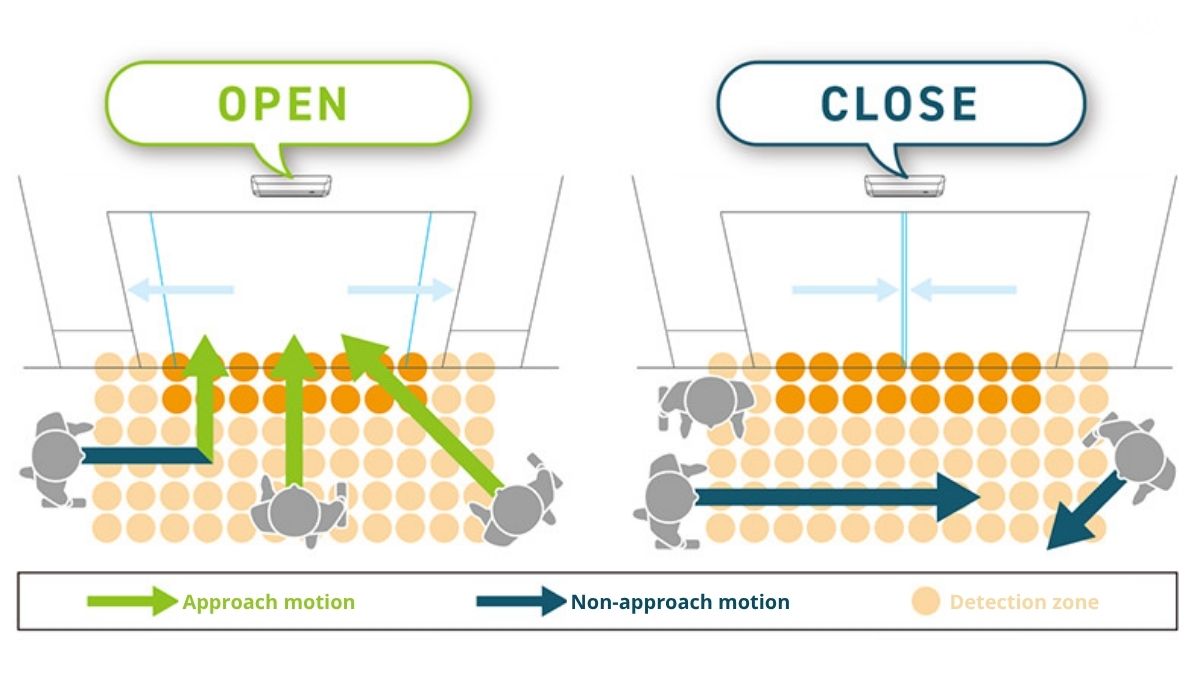
Instead of merely detecting movement, NABCO sensors analyze movement direction:
- Passing by → door remains closed
- Approaching → door opens precisely
This mechanism is particularly important in high-traffic areas such as airports, shopping malls, and hospitals, where mistimed opening can impact operations and environmental control.
Minimizing environmental interference
One of the main reasons many systems perform inconsistently is environmental interference such as:
- Strong lighting
- Highly reflective flooring
- Rain or dust
Thanks to advanced signal-processing algorithms, NABCO automatic door sensor technology filters out these factors, maintaining high accuracy under all operating conditions.
NABCO sensors recognize movement behavior: people passing by do not trigger the door, while approaching users activate precise opening
Wide detection range with high precision
Compared to conventional sliding door sensors, the NABCO automatic door sensor allows:
- Expanded detection zones
- Long-range detection
- Accurate triggering without false openings
This is particularly useful in real-life scenarios such as slow-moving users, carts, stretchers, or crowded environments.
Multi-layer sensor integration for maximum safety
A NABCO door system does not rely on a single sensor but integrates multiple layers:
- Activation sensors
- Automatic door safety sensors
- Ultrasonic sensors
This combination ensures correct opening timing and prevents closing when obstacles are present, minimizing collision risks.
Common types of NABCO automatic door sensors
To meet diverse operational requirements, NABCO develops multiple specialized sensor lines.
Activation sensors
The most common type, typically infrared or microwave sensors:
- Detect approaching users
- Trigger precise door opening
- Suitable for high-traffic areas
Safety sensors
Play a critical role in ensuring operational safety:
- Detect people or objects within the doorway
- Prevent closing when obstructions are present
- Ensure maximum safety
Ultrasonic sensors
Commonly used in high-standard environments such as hospitals:
- Detect stationary objects
- Increase accuracy during door closing
Touchless sensors
Ideal for sterile environments:
- Gesture-based activation
- Reduced physical contact
- Improved hygiene standards

Operational benefits of using the NABCO automatic door sensor
When deploying the NABCO automatic door sensor, value goes beyond technical specifications and becomes evident in real-world operation. With precise detection and fast response, the system maintains smooth and stable performance even under continuous use.
At the same time, minimizing mistimed openings or incorrect closing significantly reduces errors and operational incidents. This not only extends system lifespan but also enhances user experience, making passage through the door more natural and seamless.
More importantly, in high-density environments, the sensor system acts as a safety layer—ensuring correct responses, preventing collisions, and protecting users. Particularly in hospitals, the NABCO sensor also supports environmental control and closed-loop operations, meeting strict technical and hygiene standards.
Why large-scale projects choose the NABCO automatic door sensor?
It is no coincidence that the NABCO automatic door sensor is widely used in large-scale projects. Each type of facility has different operational requirements, but all share the need for high precision and stability.
- Hospitals: Require strict sterile standards and precise door operation to control environment and pressure
- Airports: Demand continuous operation with extremely high traffic, fast response, and 24/7 durability
- Shopping malls: Prioritize user experience, requiring smooth and uninterrupted operation
- Office buildings: Focus on convenience and operational stability
If the automatic door sensor system operates inaccurately or unstably, the entire system is affected, leading to operational disruption and reduced efficiency. This is why large projects prioritize NABCO sensor solutions—where reliability has been proven through long-term real-world use.
Why choose Sonha Auto for deploying the NABCO automatic door sensor?
To maximize the performance of the NABCO automatic door sensor, selecting the right implementation partner is as important as the equipment itself. As an official NABCO partner in Vietnam, Sonha Auto not only supplies products but also delivers synchronized and comprehensive automatic door solutions.
With over 20 years of industry experience, Sonha Auto begins with on-site surveys and consultation to select the most suitable sensor type for each project. The technical team then designs optimal detection zones, ensuring accurate performance under real operating conditions while minimizing interference.
Installation and calibration are carried out according to strict technical standards, ensuring stable operation from the start. In addition, periodic maintenance services help sustain long-term performance, reduce failures, and optimize operational costs for investors.
Thanks to this holistic approach, door systems not only “function” but achieve sustainable, stable performance that meets the demands of high-standard projects.
>>> See more: What are the key advantages of NABCO automatic door technology in modern buildings?
Conclusion
In a modern automatic door system, the sensor is no longer a supporting component—it is the decisive factor for overall performance and operational safety. With advanced technology, intelligent processing, and high stability, the NABCO automatic door sensor has established itself as the top choice for projects with stringent technical and operational requirements.
Contact Sonha Auto for consultation on the right NABCO sensor solution to ensure precise, durable, and optimized door system performance in the long term.