Electricity is essential to the operation of automatic doors. Unlike manually operated doors, automatic door systems use motors, controllers, and sensors to perform opening and closing operations in response to signals. Therefore, when the power supply for automatic doors experiences faults or fluctuations, the system may immediately develop errors, operate intermittently, or respond incorrectly to signals. What technical requirements must the power supply for automatic doors meet? How do voltage drops, sudden power outages, and electrical interference affect the system, and what solutions provide comprehensive protection? Read on to learn more with Sonha Auto.
The role of the power supply in automatic door systems
An automatic door system typically consists of a controller, geared motor, activation sensors, safety sensors, and drive components. According to the technical operating principles provided by NABCO, when a sensor detects a person or object within its activation zone, it sends a signal to the controller. The controller receives and processes the signal, then operates the geared motor to open or close the door according to the programmed settings. Therefore, the power supply for automatic doors not only provides energy to the motor but also ensures that the system’s electronic devices can function properly.
The power supply specifications must be selected according to the technical requirements of each model. For example, some NABCO automatic door models use a 230 VAC ±10% power supply, while other product lines may have different specifications. Therefore, during installation, the manufacturer’s documentation must be consulted rather than applying a single voltage standard to all types of automatic doors.
How does an unstable power supply affect automatic doors?
Abnormal voltage fluctuations
When the input voltage falls below or rises above the permitted range, electrical devices in the system may operate outside their designed operating conditions.
Possible symptoms include:
- Doors opening and closing slowly, unevenly, or inconsistently.
- The controller displaying an error or stopping operation when the power supply falls outside the permitted range.
- The motor operating outside its design specifications, particularly when starting or running under a heavy load.
If this condition occurs frequently, electronic components and drive mechanisms may experience additional stress during operation. However, not every instance of slow door movement or sudden stoppage is caused by voltage fluctuations. The motor, sliding rails, rollers, sensors, and controller should also be inspected to identify the actual cause.

Sudden power outages while the door is operating
When the mains power supply is suddenly interrupted, all automatic operations of the system will stop. Depending on the technical design, the door may remain stationary in its current position or switch to a manual operating mode.
According to NABCO’s technical specifications, standard automatic doors are designed to allow users to push them open manually with a relatively light force of less than 100 N (equivalent to approximately 10.2 kgf). This supports emergency escape in the event of a power failure. For projects requiring the door to maintain a fixed position (fully open or fully closed) during a power outage, NABCO also offers the dedicated EBS backup power unit, which automatically moves the door to its configured safe position.
Electrical interference and voltage surges
Electromagnetic interference commonly occurs when power cables run parallel to cables supplying high-power industrial equipment. Voltage surges, meanwhile, may result from switching high-load equipment on or off across the electrical network or from lightning-induced surges.
These phenomena must be distinguished because their effects differ. Electromagnetic interference may affect control signals or signal transmission if the wiring and grounding systems are not properly arranged. Overvoltage surges, on the other hand, may damage electronic components if they exceed the equipment’s withstand capacity.
In automatic door systems, the controller and sensors are among the components that require particular attention when investigating power quality issues.
Potential impact on equipment lifespan
Frequent fluctuations in the power supply for automatic doors can expose motors and circuit boards to more demanding operating conditions. Over time, this may accelerate the ageing of electronic components and the wear of mechanical parts.
However, an unstable power supply alone is not sufficient reason to conclude that an automatic door motor has failed. Actual automatic door durability depends on a combination of factors, including opening and closing frequency, door leaf load, installation quality, and periodic maintenance.
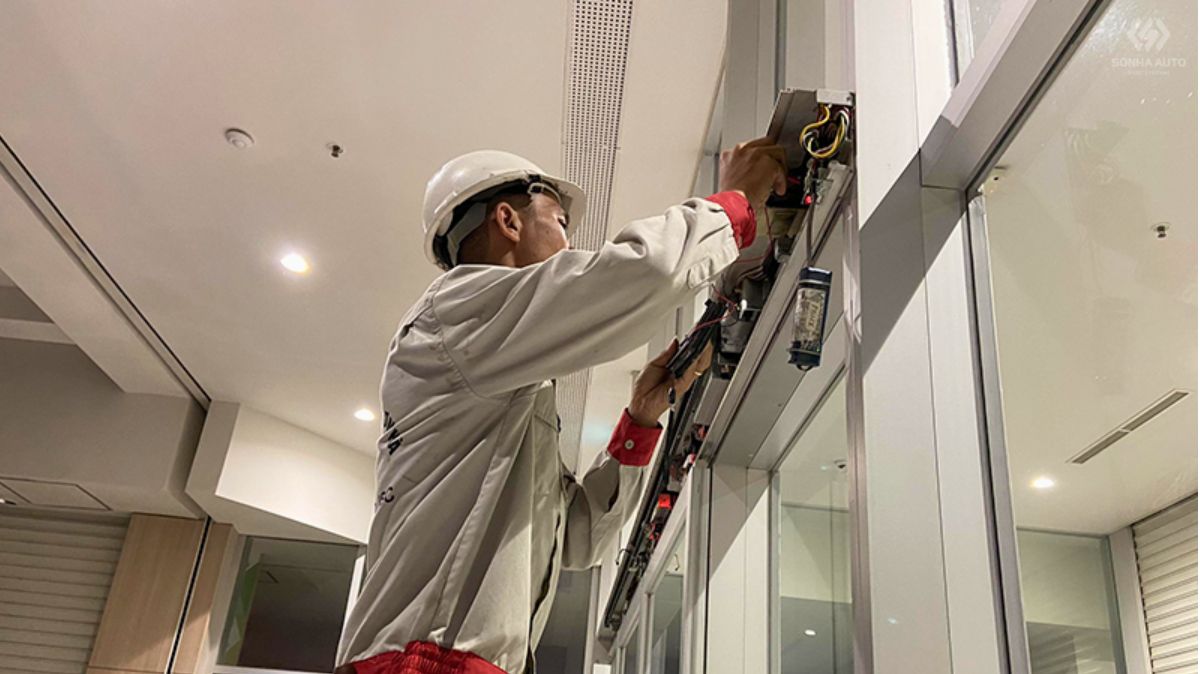
Power supply protection solutions for automatic doors
To mitigate risks arising from the mains power supply, it is essential to proactively implement protection measures for the power supply for automatic doors at the project site.
Check and stabilize the input voltage
Before connecting the system, technicians should accurately measure the voltage under load at the installation site. If significant voltage fluctuations are detected, an automatic voltage regulator (AVR) should be installed to maintain a stable output voltage within the required range. The AVR’s capacity must be calculated based on the motor’s starting current as well as its rated power.
Use a backup power supply when necessary
For areas where doors must continue operating or maintain a specific position during a power outage, an uninterruptible power supply (UPS) for automatic doors or a dedicated backup power unit may be considered.
However, these two solutions serve different purposes:
- UPS: Provides temporary power to equipment when the mains supply is interrupted. Its capacity must account for the motor’s power requirements, starting current, and the desired backup runtime.
- Dedicated backup power unit (EBS): Designed for the configuration of a specific door system. It can maintain the door in an open or closed position during a power outage or in response to an emergency signal.
Not every automatic door requires a UPS. The choice should be based on operational requirements, the emergency escape plan, and compatibility with the controller.

Install surge protection and electrical protection devices
A surge protective device (SPD) helps limit transient overvoltage transmitted through power lines, reducing the risk of damage to electronic equipment. In addition, the system should be equipped with appropriately rated circuit breakers to protect against overloads and short circuits. Wiring, grounding, and protective devices must also comply with the project’s electrical design.
These solutions serve different functions and must be properly coordinated. For example, an SPD does not replace the grounding system, while a conventional circuit breaker does not stabilize voltage.
What should you do when automatic doors malfunction due to power supply issues?
When the power supply for automatic doors shows signs of fluctuation, causing abnormal operation, jerky movement, or a complete stoppage, the following technical checks are recommended:
- Check the power supply: Confirm that the power switch, circuit breaker, and power supply lines are functioning normally.
- Observe door operation: Record when the fault occurs, where the door stops, and any abnormal symptoms.
- Check the control equipment: Observe the status indicator lights or error codes, if available. Do not change the programmed settings without authorization.
- Contact a technician: If the door still does not operate normally, the power supply, sensors, motor, and controller should be inspected together to identify the cause.
NABCO safety recommendation: If unusual noises, smoke, or a burning smell are detected coming from the door operator, users should immediately switch off the main power supply and contact the authorized distributor. Never attempt to dismantle components yourself to repair automatic doors.

>>> See more: What should be checked when assessing automatic doors after years of use?
Technical advice from Sonha Auto
The power supply for automatic doors should be checked during the site survey and installation stages, then monitored throughout the system’s operation. Ensuring that the power supply meets the specified requirements, installing appropriate protection devices, and conducting periodic inspections help reduce electrical faults and maintain stable system operation.
With more than 20 years of experience in the automatic door industry and as NABCO’s official distributor in Vietnam since 2006, Sonha Auto follows procedures for inspecting the power supply, controller, and operating components before handing over each project. When abnormal symptoms occur, a thorough site inspection to determine whether the cause lies in the power supply or the equipment itself helps building management teams select the correct corrective measures and minimize unnecessary component replacement costs.