Although they are all automatic doors, each system can differ in terms of smooth operation, control capabilities, and how well its components work together. So, what makes NABCO automatic doors different from conventional automatic doors? The difference does not lie in a single component, but in how the entire door system is designed, including the integration of the controller, sensors, operating equipment, and safety features to meet the actual requirements of each project. For a more objective perspective, let’s explore this door system in detail with Sonha Auto – the official distributor of NABCO in Vietnam in the following article.
NABCO – A Japanese automatic door brand with a history dating back to 1956
NABCO NABCO is a Japanese automatic door brand with a history of development in this field dating back to 1956. Throughout its development, the company has focused on researching and developing automatic door solutions, along with operators, controllers, and sensors for various types of buildings.
By 2025, NABCO had reached the milestone of 3 million automatic doors manufactured, marking a notable milestone in the brand’s development. This experience also provides a foundation for NABCO to continue developing automatic door solutions with different configurations and operating requirements.

Key features of NABCO automatic doors
To understand the differences between door systems, it is first necessary to look at an automatic door as a complete system rather than as a single opening and closing device. An automatic door system consists of an operator, motor, controller, activation sensors, safety sensors, belt and pulley, rail, and related components. When the sensor receives a signal, the controller processes the information and controls the motor to drive the door open or closed. The safety sensor continues to monitor the door area to help minimize the risk of collision with people or objects.
This is also the foundation on which NABCO automatic door technology is developed, with a focus on synchronization between the operator, controller, and sensors rather than concentrating on a single component. Therefore, differences between automatic door systems should be evaluated based on multiple factors, including the operator, controller, sensors, safety features, configurability, and suitability for the building.
Synchronized from the operator to the controller
In an automatic door system, the motor generates movement for the door leaves, but it is not the only component that determines how the door operates. Signals from the sensors must be received and processed by the controller, which then sends commands to the motor to open, close, or stop the door appropriately.
NABCO develops synchronized drive systems, motors, controllers, and sensors for automatic door systems. The components are designed to work together within the same system rather than focusing solely on the motor’s opening and closing capability. This synchronization is particularly meaningful for buildings with high usage frequency, where doors must continuously receive signals and perform multiple opening and closing cycles throughout the day.

Sensors designed for both activation and safety
One notable difference when examining what makes NABCO automatic doors different from conventional automatic doors lies in the sensor system. Automatic door sensors do not only detect people to activate door opening. During the opening and closing process, safety sensors also monitor the movement area to help minimize the risk of the door leaves colliding with people or objects.
In NABCO automatic door technology, sensor systems are developed with various technologies and detection areas to serve both door activation and safety monitoring. Depending on the system, sensors may use infrared, microwave, ultrasonic, or other detection methods.
The important point is not to use as many sensors as possible, but to select the right type of sensor and detection area according to the door type, installation location, and usage conditions. For some specialized NABCO door systems, the company has also developed functions for self-checking and monitoring sensor status, allowing the system to identify abnormalities during operation.

Control goes beyond simply opening and closing
For buildings with high pedestrian traffic, basic opening and closing capabilities are not sufficient to evaluate door operating performance. Automatic doors need to respond flexibly to signals from sensors and precisely control door leaf movement during each operating cycle.
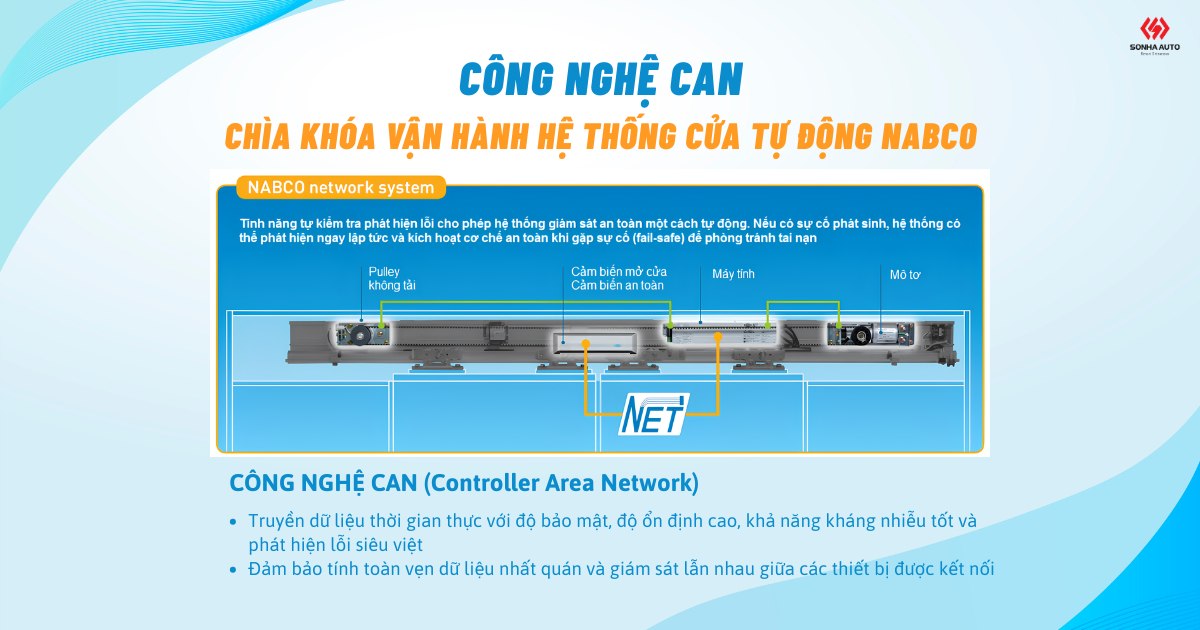
NABCO is a global pioneer in applying CAN communication technology (CAN network) to automatic door systems. By integrating this advanced solution, which is also used in luxury automobiles, NABCO’s microprocessor controller enables components ranging from the motor and sensors to circuit boards to continuously exchange data at high speed and supports real-time monitoring of operating status.
With this intelligent communication network, the system can proactively analyze and process various complex factors during operation rather than simply executing a basic sequence of mechanical commands: “person detected → door opens” and “no person detected → door closes.”
Configured according to the actual requirements of the building
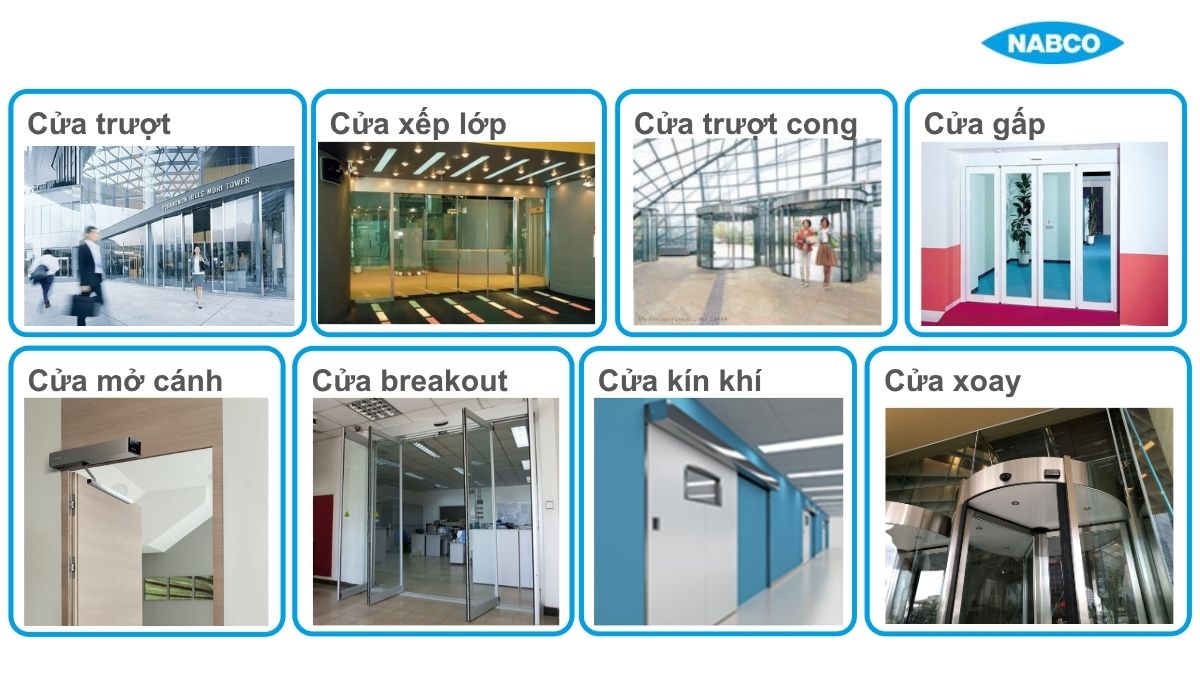
Not every entrance has the same dimensions, traffic volume, or operating conditions. A door used at a hotel lobby has different requirements from one installed in a hospital or factory. Therefore, instead of applying a single configuration to every location, NABCO automatic door solutions can be selected based on door leaf dimensions and weight, pedestrian traffic volume, opening and closing frequency, installation space, environmental conditions, and safety requirements.
Based on these factors, the building can select suitable door types and equipment, such as automatic sliding doors, automatic revolving doors, automatic swing doors, or specialized door systems. This approach allows automatic doors to be suitable not only in terms of design but also in meeting the actual usage requirements of each area.
So, what makes NABCO automatic doors different from conventional automatic doors?
Simply put, the difference between NABCO automatic doors and conventional automatic doors does not lie in a single specification, but in how the entire system is developed and how its components work together in coordination. While a conventional automatic door system may meet basic opening and closing requirements, NABCO considers drive systems, control, sensors, safety, and project-specific configuration as interconnected elements within the same solution. This is particularly suitable for buildings with high pedestrian traffic, frequent usage, or higher requirements for safety and operational performance.
Therefore, when comparing NABCO with conventional automatic door systems, instead of only asking about the automatic door price or motor power, it is important to consider how the system is designed, how its components work together, and whether it is suitable for the actual requirements of the building.
This is also the basis for choosing an automatic door solution that not only meets current usage requirements but also aims for stable and long-term operation.
>>> See more: NABCO N-Search technology: Enhancing safety and detection accuracy for automatic doors
Conclusion
What makes NABCO automatic doors different from conventional automatic doors? The answer lies not only in the brand or an individual component, but in how the automatic door is developed as a complete system. The coordination between the operator, controller, sensors, and safety solutions provides the foundation for configuring the system to suit each type of building and its usage requirements. Therefore, when choosing automatic doors, what matters is not simply whether the door can open and close automatically, but how well the entire system meets the building’s actual operating, safety, and long-term usage requirements.