Factories have different operating characteristics from offices, hotels, or shopping centers. Some areas have high and continuous pedestrian traffic, while others frequently have carts, goods, or equipment moving through. Other areas may have specific requirements for environmental control, safety, or access control. Therefore, choosing automatic doors for a factory is not simply a matter of selecting an off-the-shelf door model. The door type, dimensions, load capacity, sensors, and operating configuration need to be determined based on the installation location and how the facility is actually used. So, what should you consider when implementing automatic doors for factories*? Let’s explore the 6 important factors below with Sonha Auto.
Why should factories select automatic doors for each area?
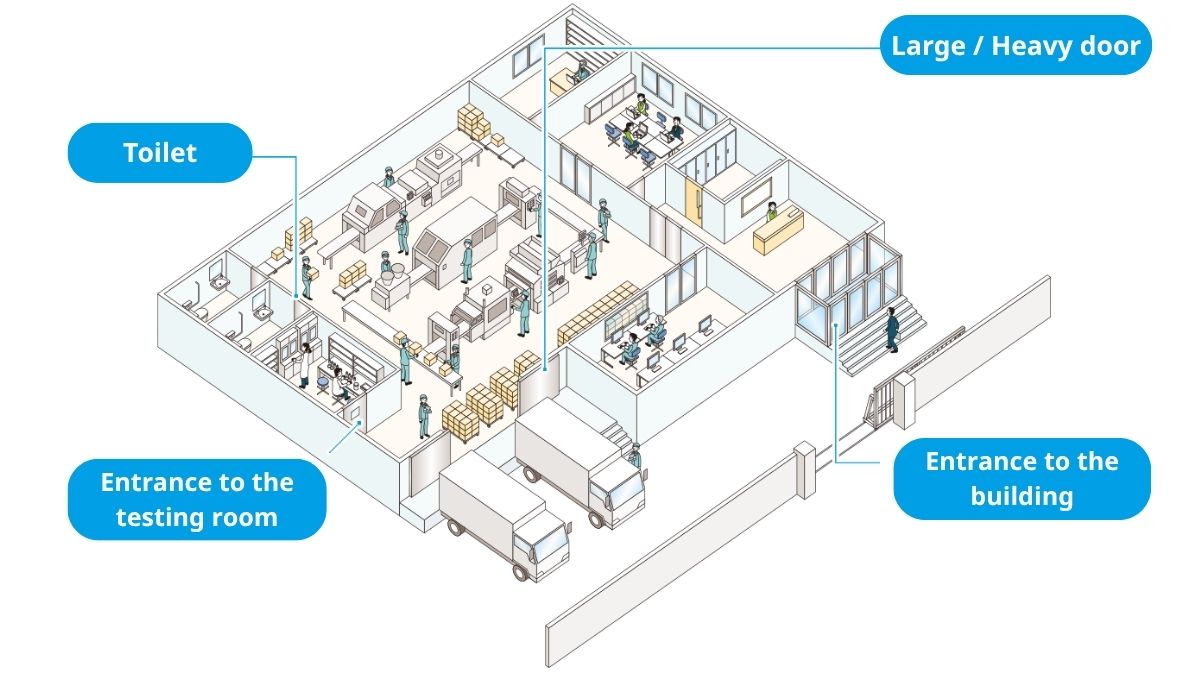
Within the same factory, an automatic door at the main entrance has completely different requirements from a door in a production area or a large door used for transporting goods. The main entrance needs to provide convenience and safety for users, while production areas may require a higher operating frequency. For large doors with heavy panels, load capacity and operating performance become priorities.
Therefore, instead of using one configuration throughout the entire facility, the purpose of each location should be identified before selecting the appropriate door type and equipment.
This is also how NABCO develops solutions for factories, with door models and configurations selected according to each space and its operating requirements.
What factors should you consider when choosing automatic doors for factories?
Determine the location and purpose of use
First, determine where the door will be installed and who the primary users will be. Common locations may include the main entrance, production areas, employee passageways, goods transportation areas, testing rooms, or areas with specific environmental and safety requirements.
Each location will have different requirements for dimensions, opening and closing speed, level of sealing, load capacity, and sensor configuration. Identifying the purpose correctly from the outset will help ensure that the selected door is better suited to actual needs.
Pedestrian traffic and opening frequency
Factories may operate across multiple shifts, with large numbers of employees entering or leaving at the beginning or end of each shift. Some areas may also have people, carts, and equipment moving continuously.
Therefore, it is necessary to assess pedestrian traffic, peak periods, the number of opening and closing cycles per day, and the primary users. These factors provide the basis for determining a suitable door configuration rather than selecting a door based solely on its dimensions or appearance.

Door dimensions and panel weight
For industrial automatic doors, large doors or doors with heavy panels require their load capacity to be calculated from the outset. In addition to width and height, the panel weight, number of panels, and door construction need to be determined so that an operator with the appropriate load capacity can be selected.
NABCO offers operator systems for various door configurations. For example, the V-250SL is developed for heavy-duty door systems, while the V-500SL is intended for doors with greater dimensions and weight.
The specific model still needs to be selected based on the actual technical specifications. The door panel weight must not exceed the equipment’s permitted limit, as this directly affects the operating performance and safety of the system.
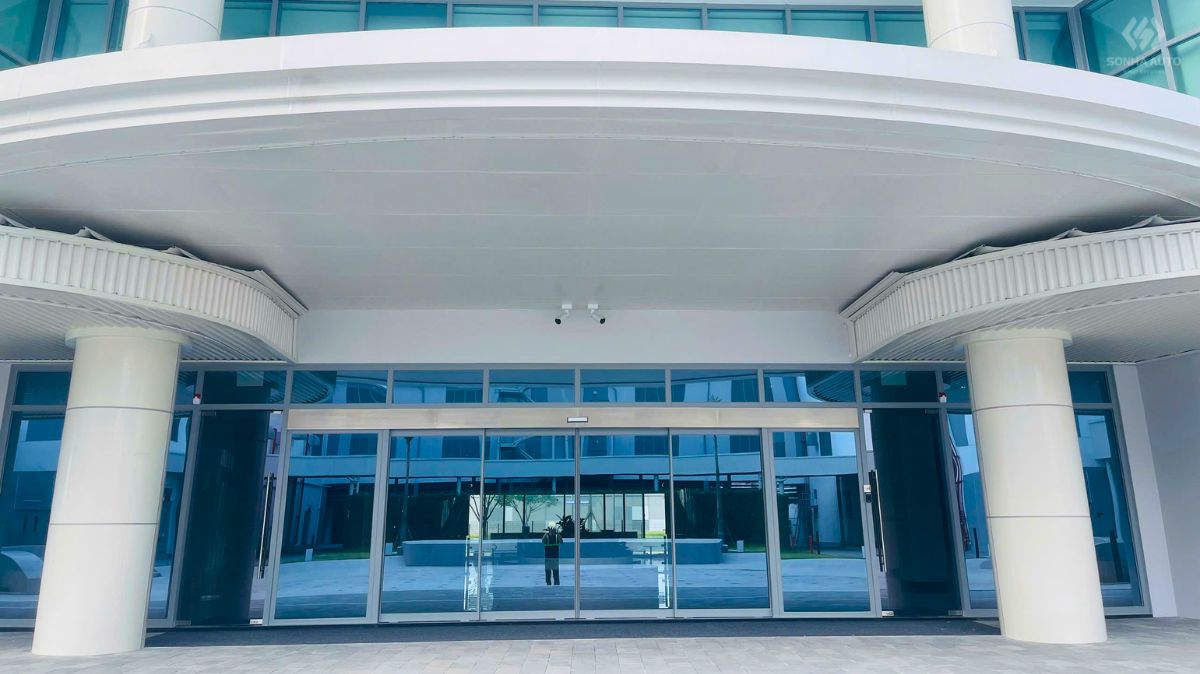
Environmental conditions and transportation requirements at the installation area
Factory environments can vary significantly from one area to another. A door may be installed indoors, outdoors, between two production areas, or at a goods receiving and dispatch area. Therefore, temperature, humidity, wind, dust, hygiene requirements, and the level of air exchange need to be considered.
In addition, it is necessary to clearly determine whether people, carts, equipment, or goods will pass through the door and what their dimensions are. If the door is primarily intended for employees, an automatic sliding door may be suitable for many locations. Conversely, areas where large equipment or goods are frequently transported may require a configuration that allows the passageway to be widened or a specialized solution.
For areas requiring control of dust, temperature, humidity, or air exchange, the door should also be selected based on specific environmental requirements rather than appearance alone.
Door sensors and safety
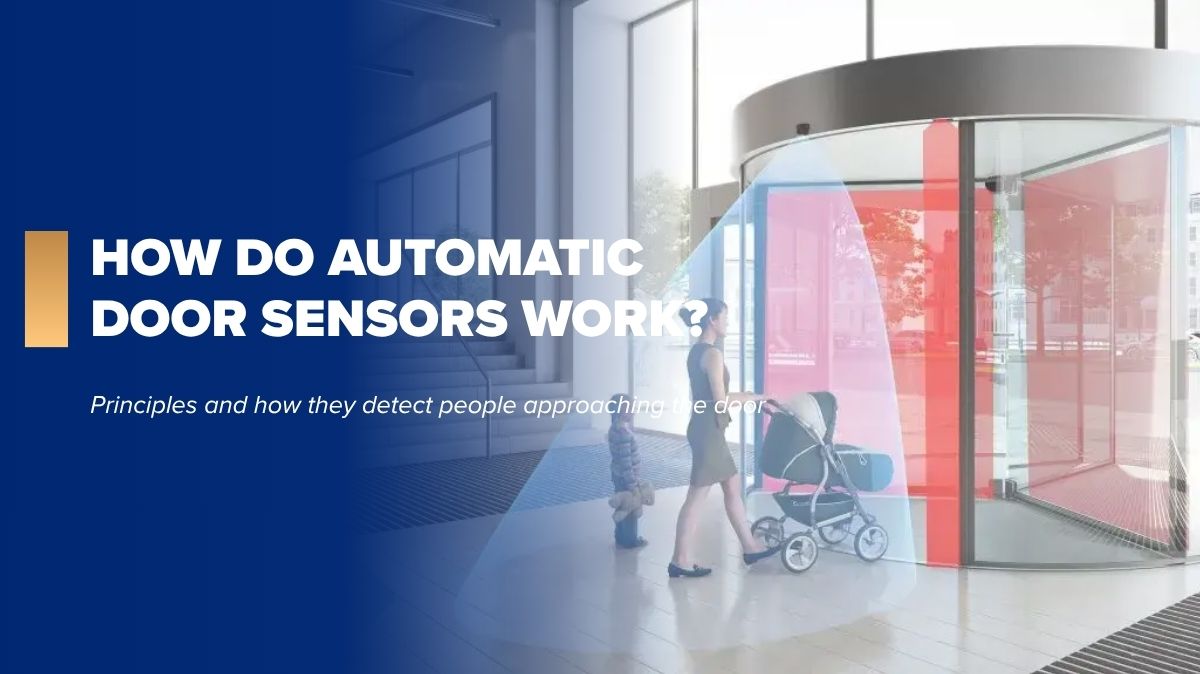
Sensors do more than simply detect people and activate the door. Depending on the configuration, the system may use activation sensors to detect people approaching the door and safety sensors to monitor the door panel’s movement area.
For factories, sensor selection should be based on actual usage. A door intended for pedestrians will have different requirements from one frequently used by carts or transport equipment. Therefore, the sensor type, detection range, and installation position should all be considered rather than simply checking whether the door has sensors.
Maintenance and long-term operation
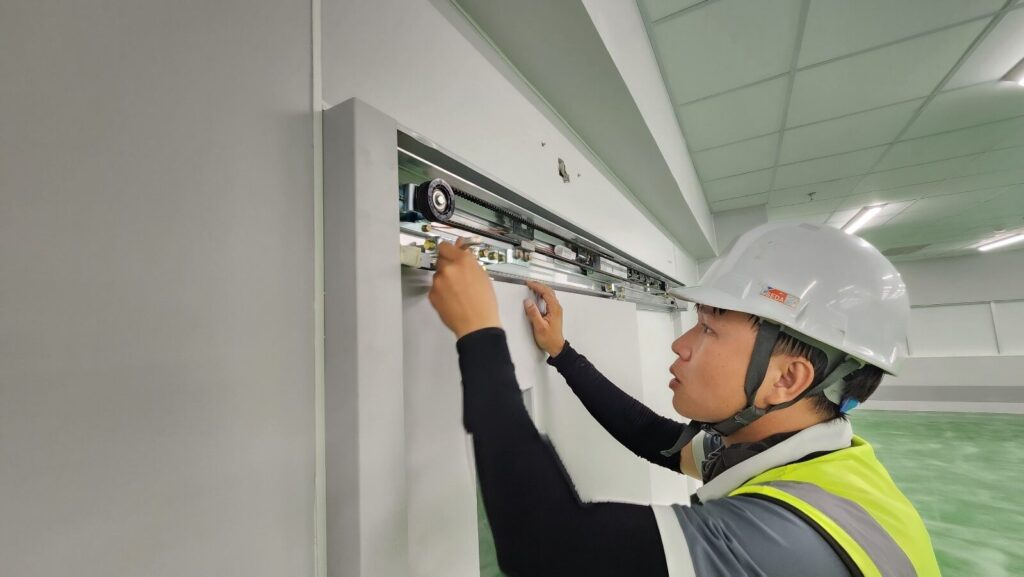
Factories typically have high door usage frequencies, so selecting an automatic door solution for factories should not be based solely on its performance when newly installed. Factors such as ease of inspection, maintenance, component replacement, and technical support should also be considered from the beginning.
A door system configured correctly for its load capacity and usage frequency can help reduce stress on mechanical components during operation. At the same time, regular maintenance helps detect wear at an early stage and maintain stable system performance.
This is particularly important for factories operating across multiple shifts, where a door shutdown can directly affect the movement of people and goods.
Select the door type according to each requirement
The factors above show that there is no single type of automatic door suitable for every area of a factory. Entrance solutions for factories should be selected based on the function and actual operating conditions of each location.
| Area/requirement | Possible solution |
| Main entrance | Automatic sliding door, revolving door |
| Employee passageway | Automatic sliding door |
| Area requiring a wider passageway | Breakout door or specialized configuration |
| Area requiring environmental control | Sealed door or specialized solution |
| Area with emergency egress requirements | Door configuration meeting the project’s safety requirements |
| Door with large, heavy panels | Cửa trượt tải trọng phù hợp |
The table above is intended only as an initial guide. The actual configuration should be determined based on door dimensions, panel weight, traffic volume, environmental conditions, and operating requirements for each area.
NABCO – Automatic door solutions for different factory areas
NABCO has developed automatic doors since the 1960s and provides entrance solutions for various types of buildings, including factories. According to information published by NABCO, the brand holds more than 20% of the global automatic door market and is working toward the milestone of 3 million installed door systems.
For factories, NABCO develops solutions according to the function of each area rather than applying a single configuration throughout the entire facility. The main entrance may use a sliding or revolving door; locations requiring a wider passageway may consider a breakout door or emergency exit door; while large doors with heavy panels require an operator with a load capacity appropriate to the application.
Areas with specific environmental, hygiene, or air-control requirements may also require specialized solutions. Therefore, the door type, operator, sensors, and control system need to be configured together according to the actual conditions.
This approach makes automatic doors for factories part of an overall entrance solution designed around the operating requirements of each area.

Sonha Auto – Automatic door consultation and installation for factories
Sonha Auto supplies and implements NABCO automatic door solutions for various types of projects, including projects with high requirements for operating frequency, load capacity, safety, and system stability.
For factory projects, Sonha Auto assesses the installation location, door panel dimensions and weight, pedestrian and goods traffic, environmental conditions, and safety requirements before recommending a configuration. Depending on the area, the solution may be a sliding door, heavy-duty sliding door, emergency exit door, revolving door, or specialized configuration.
In addition to consulting on and installing NABCO automatic doors, Sonha Auto also provides maintenance, repair, and component replacement services throughout the system’s service life, helping ensure that the system is monitored and maintains stable long-term operation.
If your factory is looking for automatic doors for production areas or needs to develop door solutions for different areas, Sonha Auto can assess the existing conditions and recommend a configuration suited to your actual requirements.
A good automatic door system should not only open and close accurately; more importantly, it should be suited to how the factory operates every day.