In modern facilities such as hospitals, shopping malls, and airports, barrier-free restrooms have become a mandatory standard. However, even when the space is well-invested and properly designed, the user experience is still not truly seamless—especially at the first “touchpoint,” which is the door system. Many users still feel confused when operating the door or are unsure about its open/closed status, unintentionally creating “invisible barriers.” Therefore, the concept of barrier-free restroom automatic doors needs to be understood more comprehensively. It is not just about automation, but also about being intuitive and easy to use for all users. So, what solution can effectively optimize this experience? Let’s explore in detail with Sonha Auto below.
Why are barrier-free restroom automatic doors still not fully effective?
From an operational perspective, most restroom automatic door systems today still face common issues that are often overlooked during the design phase.
First is the issue of intuitiveness. Many systems use buttons with symbols or colors that are not user-friendly, forcing users to “guess” how to operate instead of understanding it immediately. This is especially inconvenient for first-time users or foreigners.
Next is the operation factor. For certain user groups such as wheelchair users or people with limited mobility, pressing buttons that require high force or are positioned inconveniently can become a real barrier.
In addition, the lack of clear feedback signals such as indicator lights, sounds, or door status makes users feel a lack of control, leading to confusion or awkward situations.
These issues show that for a barrier-free restroom automatic door system to operate effectively, a more comprehensive approach is needed—one that places user experience at the center.

Key criteria of a truly barrier-free restroom automatic door system
For investors and designers, selecting the right door system is not only about technical specifications but also about real-world usability.
A true barrier-free restroom automatic door system must meet three core criteria:
- Ease of understanding: Users should immediately know how to operate the system without instructions. This requires intuitive, clear design suitable for various user groups.
- Ease of operation: Buttons must have high sensitivity, require low pressing force, and be positioned appropriately so that anyone can use them comfortably.
- Safety and hygiene: The system should integrate solutions such as automatic door sensors to minimize direct contact, while ensuring anti-jamming mechanisms and proper control of force and operating speed.
Only when all these factors are met can the system truly fulfill the “barrier-free” concept.
Control solution – The key factor shaping the door experience
Within the entire system, the controller is the component that most directly affects user experience. In practice, even with the same door system, poor control design can still create difficulties for users. Conversely, a well-designed control system makes operation natural, seamless, and intuitive.
This is why modern entrance solutions focus not only on mechanical structures or motors, but especially on how the door responds to users.
HDS-4P – A control solution for barrier-free restroom automatic doors from NABCO
Within the NABCO automatic door ecosystem HDS-4P is developed as a dedicated control solution for barrier-free restrooms.
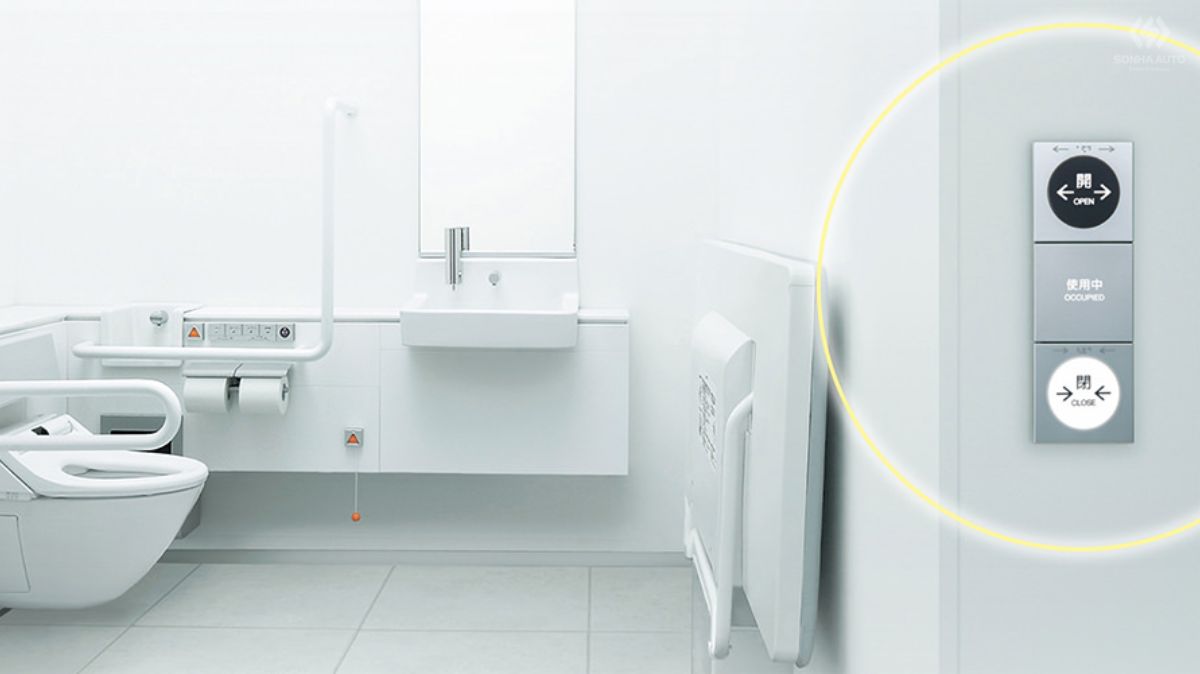
Unlike traditional push-button systems, the HDS-4P restroom controller is designed based on real user behavior research, aiming to simplify the entire operation process.
This solution does not just operate the door—HDS-4P provides an intelligent control system that helps users understand each step naturally and easily.
This is the key difference that enhances the experience of smart restroom automatic doors in modern facilities.
How does HDS-4P improve user experience?
One of the most distinct advantages NABCO brings to the HDS-4P is its ability to guide users step by step. As soon as the open button is pressed, the system responds with both light and sound to confirm that the action has been executed. When the user enters, the next signal appears, guiding them to close and lock the door.
Statuses such as “in use” or “locked” are clearly displayed on both sides, completely eliminating ambiguity during operation. As a result, the experience no longer depends on learning how to use the system, but becomes an intuitive process suitable for all users.
Touchless automatic doors – Enhancing hygiene standards
As buildings increasingly prioritize safety and hygiene—especially after pandemic periods—touchless automatic doors are becoming a new standard. The HDS-4P controller can be flexibly integrated with automatic door sensor systems, allowing users to operate without direct contact with device surfaces.
This not only reduces the risk of cross-contamination but also enhances the overall user experience, making it particularly suitable for facilities such as hospitals, airports, and shopping malls.

Flexible implementation for all projects
Not only suitable for new constructions, the HDS-4P smart control button is also an ideal choice for renovation projects. Thanks to its flexible modular design, the system can be easily installed or upgraded without requiring changes to the existing door structure.
This helps optimize investment costs while quickly improving the experience of barrier-free restroom automatic doors. It is a key advantage for investors in optimizing both cost and implementation time.
Comprehensive NABCO automatic door solution by Sonha Auto
When integrated with NABCO automatic sliding doors, the HDS-4P controller is not just an operational device but becomes part of a comprehensive solution for barrier-free restroom automatic doors.
The synchronization between motor, sensors, and control system ensures stable, safe operation and delivers a seamless experience for users. In particular, this solution is directly consulted, supplied, and implemented by Sonha Auto the largest NABCO distributor in Asia—ensuring it is well-suited to the actual operational conditions of each project.
With over 20 years of experience in the automatic door industry, Sonha has partnered with numerous large-scale projects such as shopping malls, hospitals, airports, and high-traffic public facilities.
Beyond equipment supply, Sonha Auto optimizes the entire entrance solution—from design consultation and configuration selection to installation and real-world operation.
Its practical implementation capability and deep understanding of NABCO products ensure that every door system not only meets technical standards but is also truly user-friendly, safe, and efficient in daily operation.

>>> See more: Automatic doors safe for children – An optimal solution with NABCO NATRUS doors
Conclusion
In modern buildings, quality is not only evaluated through design but also through real user experience—starting from the smallest details. Investing in and choosing the right barrier-free restroom automatic door solution with intelligent control systems like HDS-4P not only enhances convenience but also demonstrates professionalism and a human-centered design approach.
Contact Sonha Auto today for consultation on suitable NABCO automatic door solutions—optimize user experience and elevate the standards of your project.