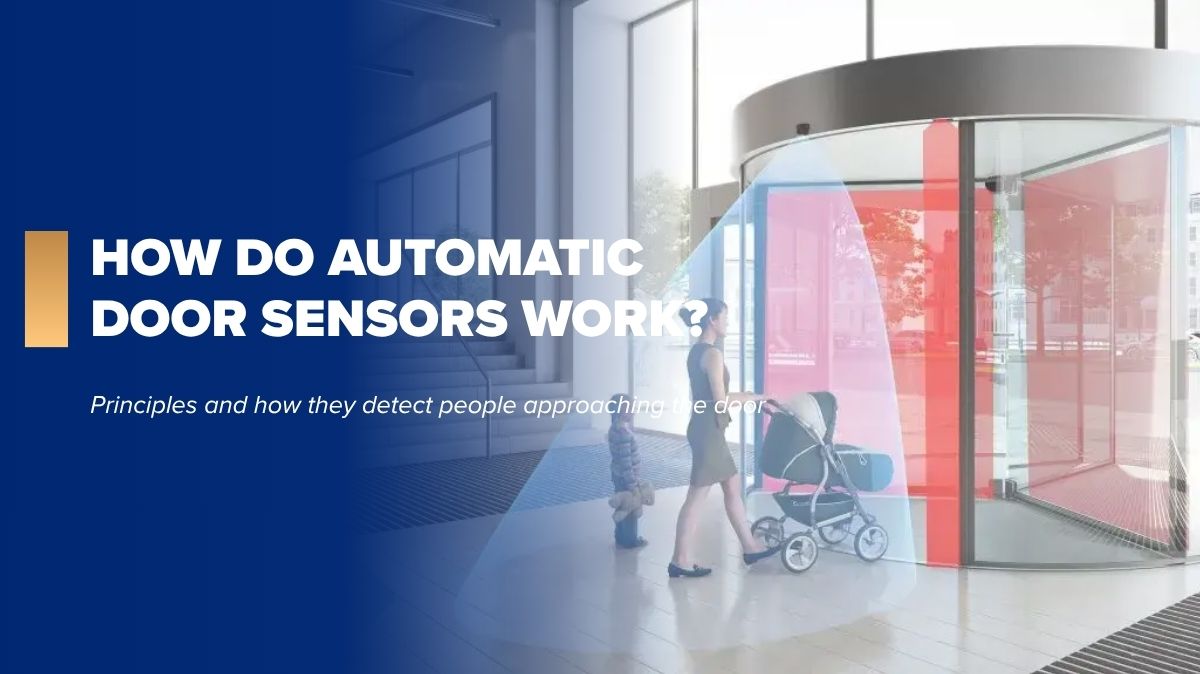
When approaching an automatic door, we usually only see the door open at the right moment and close after we pass through. Behind this seemingly simple operation is a sensor system that continuously monitors the door area, detects movement or presence, and sends signals to the controller. So, how do automatic door sensors work, and why can some systems distinguish between people who intend to pass through the door and those who are simply walking past it? Sonha Auto will explain the answer in detail in the following article.
What is the function of an automatic door sensor?
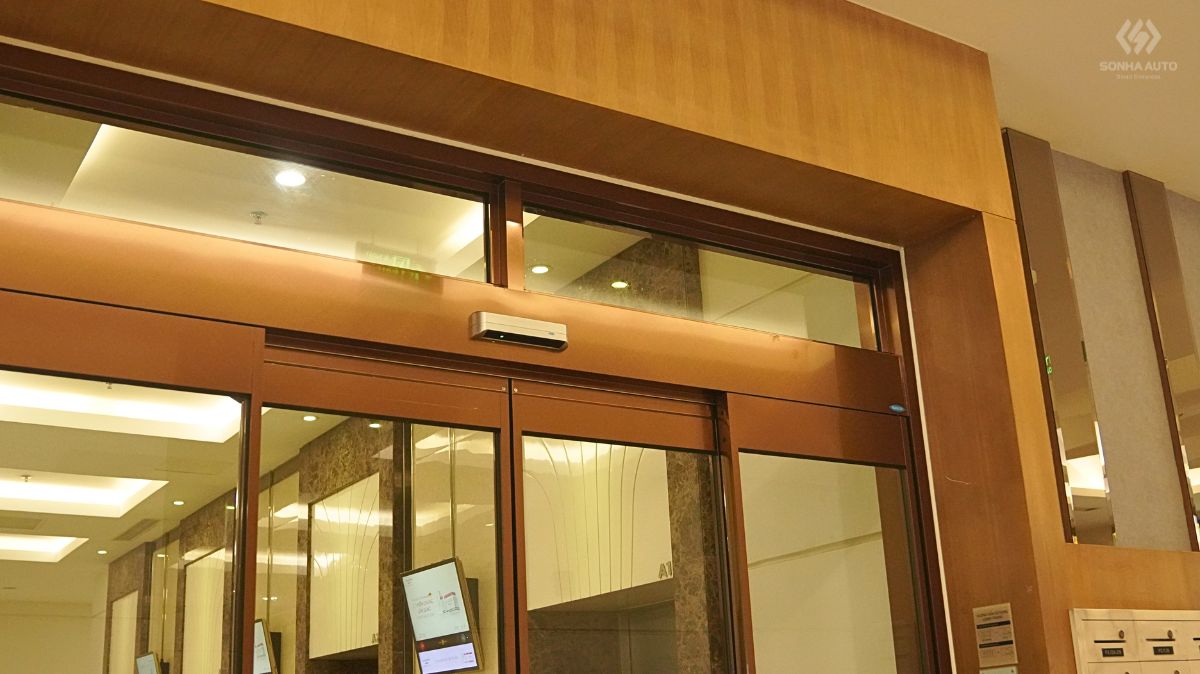
Simply put, a sensor, also known as a motion sensor or door-opening sensor, is a component used to detect the movement of people and objects in an automatic door system. When someone approaches, the sensor detects changes within the configured detection area and sends a signal to the controller. The controller then issues the appropriate command to open the door, keep it open, or close it depending on the operating conditions.
However, a sensor does not always perform the simple task of detecting whether someone is present. Depending on the integrated technology, the device may detect movement, presence, direction of travel, or monitor the area immediately around the door, depending on the function of each sensor type.
For example, NABCO currently uses various sensor technologies, including infrared sensors, microwave sensors, and image sensors. Therefore, how an automatic door sensor detects people depends on the specific model and the intended application of the building.
Operating principle of automatic door sensors
The operation of an automatic door system can be understood as a three-step process: Detection → information processing → control signal transmission.
- Detection: When a user enters the sensor detection area, the sensor records a physical change or signal based on the technology used by the device.
- Processing & signal transmission: The signal is processed to determine whether the activation conditions have been met. If the conditions for opening are satisfied, the command signal is sent to the central controller to activate the operator (motor and drive system) and open the door.
- Maintaining & closing: Once the user has passed through and there is no longer a need to keep the door open, the system continues to check the safety area before carrying out the closing cycle according to the preset time.
The key point lies in the sensor’s analytical capability: an automatic door sensor that only detects simple movement processes information very differently from a smart sensor that can also analyze the direction and speed of movement.
Current automatic door sensor technologies for detecting people
Infrared sensors – Detecting changes within the sensor area
Some automatic door sensors use near-infrared reflection technology to detect the movement or presence of people and objects. In the area immediately around the door panel, this technology is used to create a “protection area”, helping the system accurately detect people or objects standing in the hazardous area.
A typical example is the N Search sensor series from NABCO. The device uses near-infrared reflection technology for both motion and presence detection. In particular, some models also integrate an automatic safety function check after each opening and closing cycle.
Microwave sensors – Detecting movement over a wide area
Another method is the use of microwave sensors, which operate based on the Doppler effect to detect movement. The outstanding advantage of microwave technology is its ability to create a very wide detection area, making it particularly suitable for entrances with high pedestrian traffic or where the door needs to be activated from a distance.
Typical NABCO Doppler microwave sensor models include EAGLE1 and FALCON, which are designed to perform optimally in spacious lobby areas.
Image sensors – Accurately analyzing movement direction and speed
In newer-generation sensor systems, devices can combine image sensing with infrared technology to perform in-depth analysis of human movement within the scanning area.
The NABCO NSW-A01 N Search W is a typical example. This sensor combines two sensing methods, infrared and image sensing, providing a wide pedestrian flow detection area of up to 5 m × 4 m. Notably, the system does not simply identify the presence of an object; image data is also processed by algorithms to determine the target’s size, speed, and direction of movement, thereby accurately predicting when the user will approach the door.
The NABCO NSW-A01 image sensor analyzes movement direction and speed
Why do smart sensors prevent the door from opening when someone is simply walking past?
This is the key difference between generations of automatic door sensors:
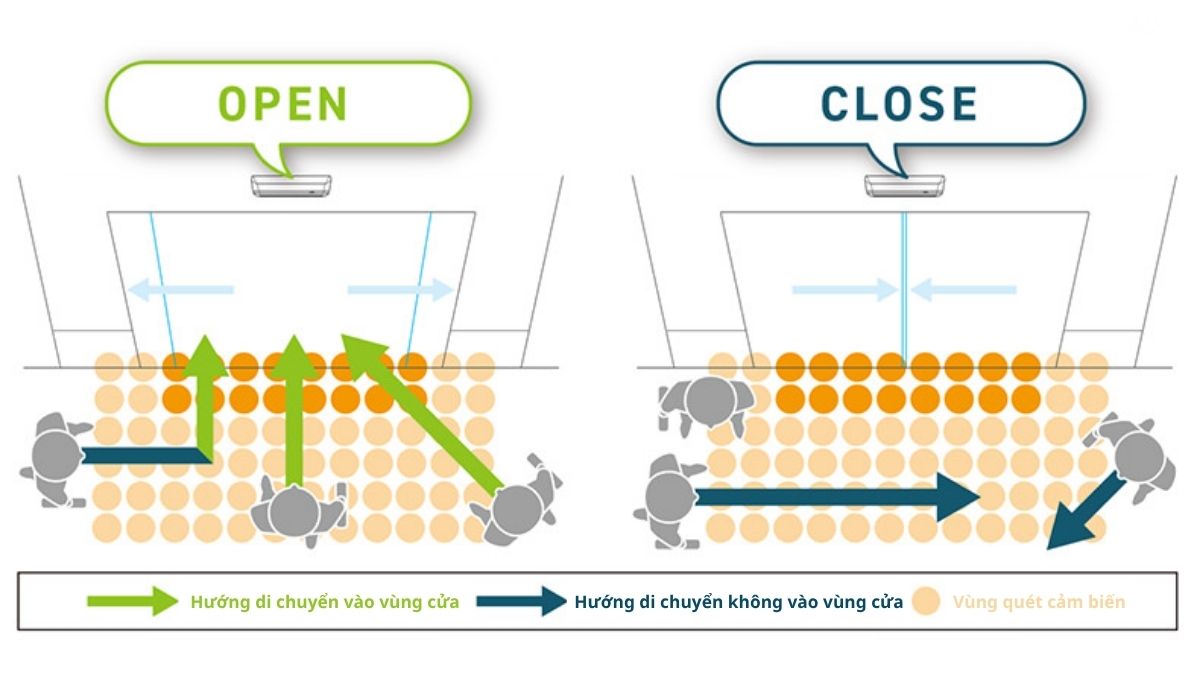
- Traditional sensors: Simply rely on the presence of an object within the scanning area. As a result, someone who accidentally walks close to the door can trigger it to open, causing air-conditioning energy loss and increased energy consumption.
- Smart sensors (movement direction analysis): By analyzing the direction and flow of movement, the system has sufficient data to determine whether a person is actually approaching the door or simply moving parallel to it.
The NABCO NSW-A01 sensor is designed based on this principle. The sensor can clearly distinguish between people intending to pass through the door and those simply walking past, thereby eliminating unnecessary door openings. At the same time, the device uses movement speed to calculate the appropriate opening time, allowing the door to open just as the user approaches and creating a smooth and natural passage experience.
For buildings such as apartment building lobbies, hotels, shopping malls, and large office buildings, this feature provides significant practical value in saving energy and extending equipment service life.

The role of sensors in ensuring automatic door safety
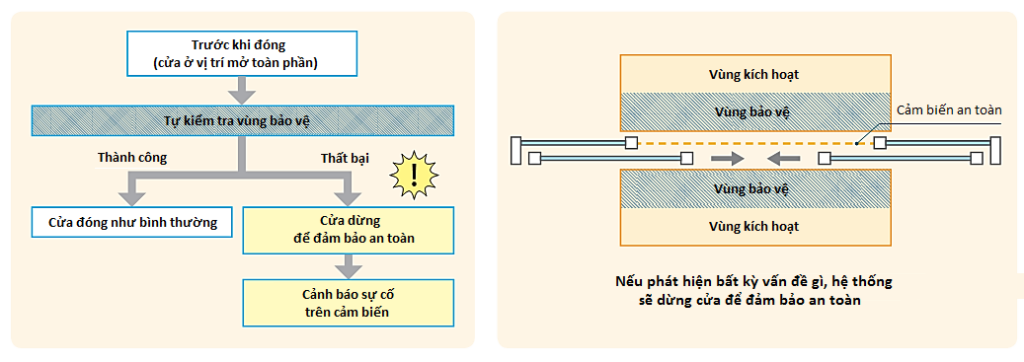
Automatic door sensors are directly related to safety, but two functions should be clearly distinguished: door activation sensors and safety protection sensors. In addition to detecting people to activate the door, a safety sensor continuously monitors the area immediately around the door panel to help detect people or objects remaining within the protection area and prevent the door from closing while the area has not yet been cleared.
For example, the NABCO NSW-A01 sensor uses near-infrared reflection technology in the protection area immediately around the door. The device continuously monitors the area and automatically checks the safety signal after each operating cycle. Therefore, when evaluating a sensor system, the assessment should not stop at the question, “Can the sensor detect people?” It is also necessary to consider the detection method, scanning range, and whether its function is activation, keeping the door open, or safety protection.
How to choose the right automatic door sensor for a building
The most expensive or most advanced sensor is not necessarily the best choice. An optimal sensor system is one selected according to the door type, installation location, pedestrian traffic volume, and actual environmental conditions:
- Limited space: Requires sensors with a narrow scanning angle and a compact detection area to avoid interference.
- Wide lobbies, high traffic volume: Require microwave sensors or image sensors with a wide scanning area and pedestrian flow analysis capabilities.
- Special environments: Factors such as rain, fog, strong light, or reflective flooring can affect sensor signals, requiring equipment with good interference resistance.
For this reason, NABCO has developed a diverse sensor ecosystem, including infrared, microwave, and image sensors with various installation configurations, to precisely address the requirements of each building rather than applying a one-size-fits-all approach.
>>> See more: Automatic doors for modern buildings: Enhancing the entrance
Conclusion
In essence, an automatic door sensor is the intelligent link between the user and the controller. The more accurately a sensor collects and processes data, the more smoothly, safely, and energy-efficiently the automatic door operates. However, actual operating performance also depends heavily on the installation position, scanning angle, configuration settings, and synchronization with the controller. For buildings with high pedestrian traffic, sensor solutions should be carefully calculated from the initial design stage.
With experience in implementing automatic door systems, Sonha Auto can support site surveys and provide consultation on sensor types and configurations suitable for the entrance characteristics, pedestrian traffic volume, and actual conditions of each building. Contact Sonha Auto today for professional support!